Are Aftermarket M18 Batteries Safe? The Complete UK Guide
What makes a compatible M18 battery safe or dangerous — cells, BMS and certification explained, with a printable UK buyer checklist.
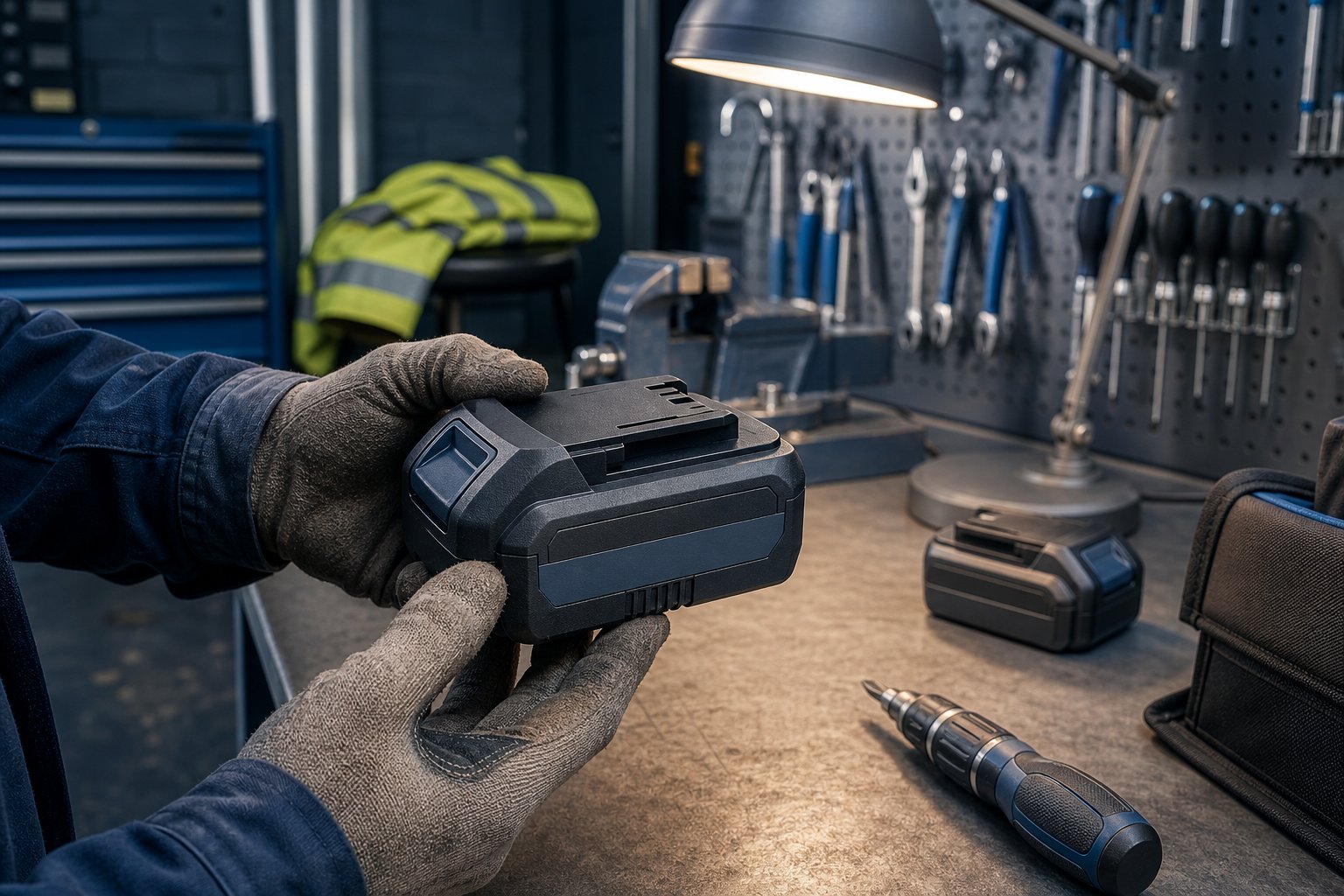
Aftermarket M18-compatible batteries are safe when — and only when — three things are verifiably true: the pack uses named lithium-ion cells from a known manufacturer, it carries a full six-protection battery management system (BMS), and it holds recognised safety certification such as UKCA marking with IEC 62133 testing. Packs that hide any of the three are the ones behind the horror stories.
That is the short answer. The long answer is worth five minutes of your time, because this category genuinely contains both perfectly engineered batteries and packs that UK regulators have pulled off the market for fire risk. This guide gives you the same checklist we apply to our own POWTREE twin-pack, so you can judge any compatible battery — including ours — with your own eyes.
Why the fear is rational (and where it actually comes from)
In 2023 the UK Office for Product Safety and Standards recalled a series of Vanon-branded lithium-ion tool batteries. The official reason, published on GOV.UK, is worth quoting because it is the whole safety argument in one sentence: “the battery packs do not have an adequate Battery Management System (BMS) to protect the product from overcharging, overheating, and igniting.” The packs also showed off-load voltage far above the label rating, and shipped without proper storage or charging instructions.
Notice what the recall did not say. It did not say aftermarket batteries are inherently dangerous. It said this pack lacked specific, checkable protections. That distinction is the entire point: safety in lithium-ion packs is not a brand attribute, it is an engineering attribute. A pack either has protective hardware or it does not.
Tradespeople on Reddit have documented the same failure modes from the other direction. One widely shared teardown of a cheap M18-compatible pack found the circuit board exposed under nothing but a paper sticker, where a genuine pack has a sealed housing that resists splashes. Others report budget packs dying after six to twelve months of light use, or cracking open after a workbench-height drop and leaving the terminals loose — a genuine short-circuit hazard in a dusty workshop.
Every one of those complaints maps to one of the three checkpoints below.
Checkpoint 1: the cells — demand a name, not an adjective
A battery pack is ten cylindrical cells in a plastic shell. Everything else is packaging. So the first question for any seller is simple: which cells, exactly?
“Premium-grade lithium-ion cells” is an adjective, not an answer. A trustworthy answer names a cell family you can look up — high-drain 21700 or 18650 cells with a published datasheet. This matters because independent teardowns of fake and bargain packs (Project Farm’s widely cited test is the best known) measured individual cells at 1,520–2,082 mAh in packs sold as high-capacity, against 3,140 mAh cells in the genuine article. The pack lies because the cells inside are small.
Public cell databases make verification possible for anyone. Open datasets such as the celljar project aggregate lab test data for hundreds of 18650 and 21700 cells, so once a manufacturer names its cell, the claimed capacity can be checked against published measurements. Before buying, ask for the cell brand, full model, nominal capacity and pack configuration; treat a capacity claim as unverified when a seller cannot provide those details.
If a seller cannot or will not tell you what is inside the shell, walk away. That single question filters out most of the dangerous end of the market.
Checkpoint 2: the BMS — six protections, listed one by one
The BMS is the circuit board that stands between normal use and the failure the Vanon recall described. A complete BMS for a tool battery provides six protections, and a seller should be able to list them without hedging:
| Protection | What it prevents |
|---|---|
| Overcharge cut-off | Cell voltage climbing past safe limit on the charger |
| Over-discharge cut-off | Deep drain that permanently damages cells |
| Over-current protection | Current spikes beyond rated draw under stall load |
| Over-temperature cut-off | Thermal runaway during heavy use or hot charging |
| Short-circuit protection | Instant shutdown on terminal short |
| Cell balancing | Individual cells drifting apart over charge cycles |
The recalled packs failed precisely here — no adequate BMS, so overcharging went unchecked. When you shop, look for the protection list on the product page. Fewer than six named protections, or a vague “built-in smart protection”, deserves a follow-up question before any money changes hands.
Ask the seller to name the BMS protections, their trigger conditions and recovery behaviour. A supplier that cannot document these basics gives you no sound basis for trusting a high-current battery pack.
One more technical point that surprises people: the M18 platform itself is an open book. Hobbyists have reverse-engineered the battery’s serial diagnostics (the m18-protocol project on GitHub reads a pack’s health registers with a £5 serial adapter), and enthusiast communities routinely test packs they buy. A compatible battery cannot hide sloppy engineering for long — which is exactly why we would rather publish our numbers first and invite the checking.
Checkpoint 3: certification — UKCA, IEC 62133 and transport testing
Third checkpoint: paperwork that someone else can verify. For batteries sold in Great Britain the relevant marks and standards are:
- UKCA (or CE) marking on the pack and documentation — the legal conformity mark for the GB market;
- IEC 62133 — the international safety standard for sealed lithium cells and packs; a certificate number you can quote is worth more than a logo on a label;
- UN 38.3 — transport testing every lithium battery must pass before it can legally be shipped by air or sea.
Ask for certificate numbers, not just symbols. A printed CE mark costs nothing to fake; a certificate number that fails to check out is evidence you can act on. For any pack you are considering, request the UKCA or CE declaration, IEC 62133 report reference and UN 38.3 transport-test summary before treating its compliance claims as verified.
The printable checklist
Before buying any M18-compatible battery — ours included — run this list:
- Cell manufacturer and model named in writing? Cross-check the datasheet capacity.
- All six BMS protections listed individually?
- UKCA/CE plus IEC 62133 certificate number and UN 38.3 confirmation supplied on request?
- Pack weight plausible? An 8Ah 18V pack of ten 21700 cells has a physical minimum weight; a suspiciously light pack contains less battery than advertised. See our capacity self-test guide for the exact method.
- Seller reachable at a UK address, with a warranty measured in months, not adjectives?
- Price sane? Quality cells have a real cost. A twin-pack at £30 cannot contain what it claims.
Points 1–3 are the engineering; points 4–6 are the commercial signals that correlate with cutting corners. Any “no” is your cue to keep looking.
Where POWTREE stands on each point
We sell one product on this site: a twin-pack of 8Ah M18-compatible batteries with a charger at £157.92. Our answers to the checklist — cell identity, BMS specification, certification numbers, plus measured capacity, cycle life and temperature data — live on the test report hub, each entry marked either with published data or an honest “pending” while factory test results are compiled. If a number is not yet published, we say so rather than inventing it. Questions the report does not answer are collected in our FAQ, and if yours is not there, email us and we will add it with a straight answer.
That is what “safe” looks like in this category: not a promise, but a paper trail you can check.